Dear You,
I can’t believe this year has come to a close; it’s been truly disorienting and fueled primarily by cortisol.
I’m certain I have not yet learned my lessons, but I’ve dog-eared some critical components.
We kicked off Artifice Season 12 in July, bright-eyed and bushy-tailed, all full of magic and ready to find more. I swooned over the beautiful connections this project brings me, introduced my ongoing search for archetypal art behaviors, and mused about the “little loves” of our individual creativities.
For August, the focus was on the primal desire to be fully seen, and the pull toward deeper, more radically unique authenticity in our works.
September’s conversations (and my very own human challenges) had me pondering about the pursuit of vision and the importance of exuberant exploration toward that end.
As we pass through our tailor-made “hallways of non-rejection,” we do well to keep an eye out for treasures and synchronicities, personalized winks from the universe, all the while striving to integrate disparate pieces of ourselves.
Most recently, October found me all in a muddle about the limits of personal ethics and optimism, and left me restless and wary, wondering whether I might need to adjust my long-held inclination toward loving without fear.
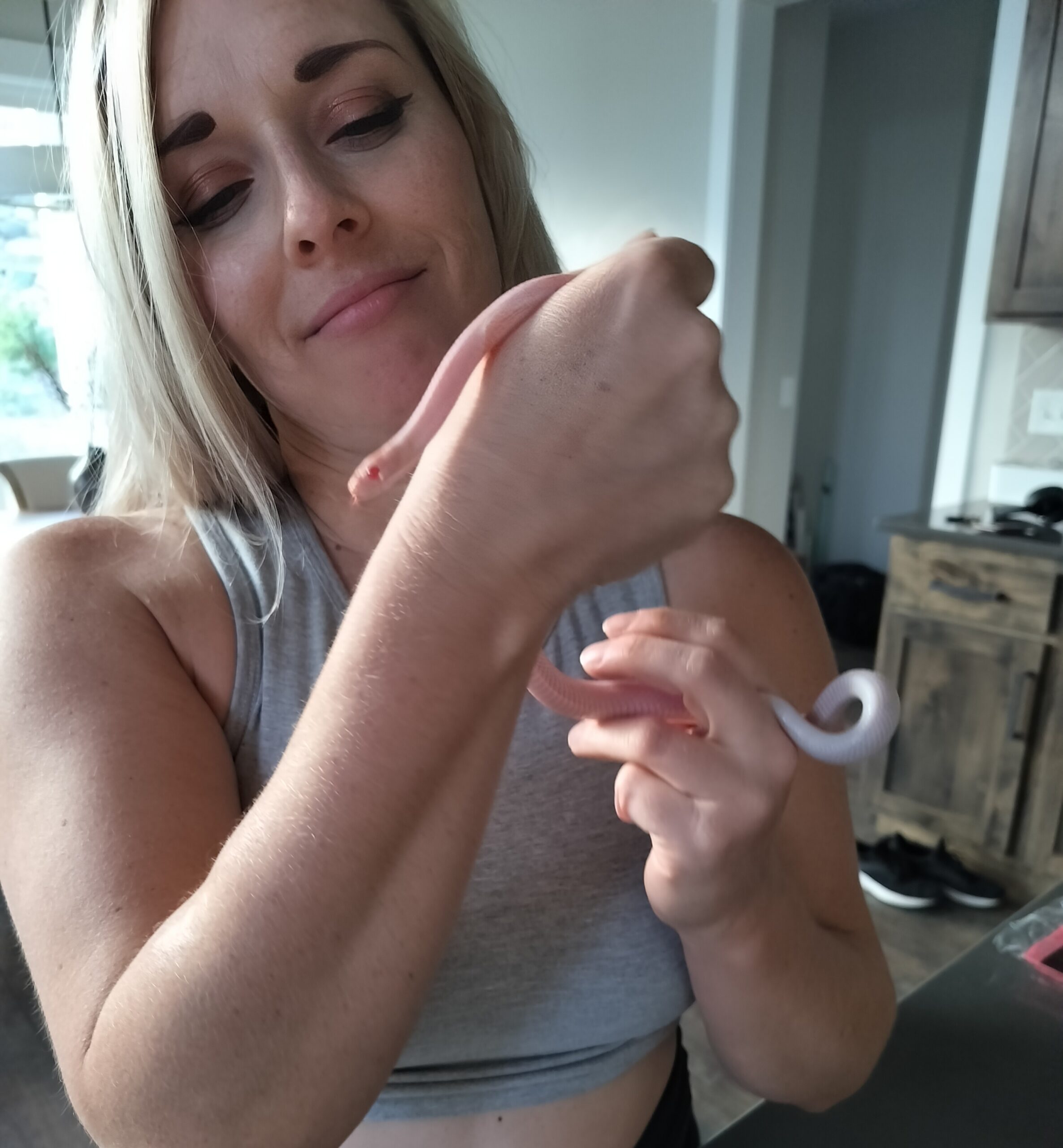
At present, I remain confused about and caught between so many things. I long for clarity. But I have been finding comfort in the symbolism provided by the Year of the Wood Snake (from the Chinese Zodiac).
I’ve let go of so much this year. I’ve cut ties with biological family in ways I’ve been utterly terrified of for maybe as long as I’ve been alive.
And while these particular sheddings were undeniably necessary (I really couldn’t hold on to those false hopes or remain in those systems any longer), I find myself wondering whether I’ve shed enough.
Have I let go of enough old habits? I think certainly not, though I’m unsure of what to peel away next.
For example, I’ve been confused about people pleasing. My therapist and closest friends say they wouldn’t exactly describe me this way (lord knows I displease plenty of people and am stubborn about plenty of personal standards), but those who know me well agree my sincere desire to treat others carefully coupled with my perpetual fear of never belonging sometimes leads me to bend in ways that don’t serve me well.
But what manner or magnitude of accommodation and amenability facilitates adaptive, responsive leadership? What measure of generosity promotes robust friendship? To what extent could alacrity enrich a practice of conscientious citizenship?
I can’t tell if my genuine ease toward ebullient plasticity is a decent and equitable trait, or whether it’s the product of a lifetime of not mattering within various abusive systems.
I’m generally confused about the role of fear in my life, which fears to heed and which to eschew.
And I’m confused about patience and forgiveness. I find the line between virtue and maladaptation endlessly wiggly and opaque.
They say this year calls for strategic introspection. Luckily, I think I’m crushing that one. And I’m also pretty jazzed about the fact that the lunar year ends February 17, giving me a little extra time to contemplate the aforementioned puzzlers, to plan ahead, and to undergo any further transformation that will prepare me for growth and innovation in the coming year.
I’m thinking a lot about what is and isn’t sustainable for me. I want to be more embodied. I want to root further into my intuition, my autonomy, my agency. I want to celebrate the story I’m writing. And I want to find and practice new magics.
Now, fifty-six essays in, I feel the need to definitively state (in case it wasn’t already clear) that while of course one goal of this Deep Dive practice is to focus on Artifice—my guests and the wisdom they’ve shared with me—I am always principally focused on the lessons I need to learn.
There’s no willy nilly-ness about it. I’m not looking for lessons that someone somewhere else might theoretically find useful (though I do hope you’ll find them useful). I’m mining this homespun wellspring for my lessons.
Weeks ago, when I last looked at my notes from November’s episodes, I’d tentatively planned to focus this essay on Passion, Purpose, and Profundity, themes that arose (more or less explicitly) in all three conversations, and that feel instinctive to me.
The truth is, I’d still like to get there. But lacking clarity as I am at present, it feels slightly fraudulent (at least contrived) to charge in with that kind of lofty confidence.
Instead, I find myself pouring over these notes, hunting solutions for my own perplexities, holding out for an illuminated route through all fifteen of this season’s cherished conversations. I believe the complete lessons are here for me. I’m just not certain exactly how to distill them.
So, rather than heading full sail into a single, succinct subject, I’m inclined today to hold my own heartful yearnings in mind and to revisit this season’s existing lines of inquiry, crosschecking November’s notes as I do.
Reexamining things through this lens, I’m feeling fairly delicate recalling that my summer-self dove into Season 12’s collection of essays with joyful connection at the forefront. I was feeling so hopeful then.
My snake year troubles are multifold, but meaningful connection is right at the top of the wish list. I’m desperate to solve my people problems, desperate to unlock my timeworn survival strategies and open the door to more balanced, trusting, mutually supportive relationships.
And I appreciate the reminder that my Artifice conversations are a fruitful source of connection, as well as excellent practice.
In a second stroke of serendipity, November’s first guest, clarinetist and author (memoirist) David Singer, shares a gorgeous perspective on the subject.
Having spent his career primarily focused on chamber music, David has come to see a small, conductor-less ensemble as a wonderful workshop for cooperation and community. In his words, “it’s a laboratory for the whole world.”
David frames this sort of music-making as a conversation among trusted friends, “your two or three favorite people in the whole world, sitting at a table where you’re facing each other and you have time to share something, to talk.”
He points out that without a conductor, space is left for the musicians to be more “actively involved with expressing.” The experience becomes much more collaborative.
Each member of the group is, of course, invested in the music overall, but will likely be particularly moved by various moments within a piece. In other words, everyone will have an idea of what could make the music come alive, and everyone works together to balance each other’s priorities in a way that honors each individual, the collective, and the music itself.
As the melody shifts from one instrument to the next, the role of each musician shifts, as well. But it’s not a simple on/off switch. Rather, the melody-holder must come forward, claim a perspective, take the floor, and the task of the others becomes actively supporting their comrade, “encouraging them to come out.” There’s nothing passive about it.
You have to tune your ears, your heart, your attention so carefully in order to master these handoffs, to realize the fluidity of your own position.
Speaking to the adjacent problem of applying one’s musical skillset to a less familiar genre, instrumentation, or setting, drummer Wade Ronsse asks himself, “how can I take this square peg and actually make it fit in the circle hole by adjusting some things, changing an angle on some things?”
He sorts through all available skills and experience, mobilizes what’s relevant, and adjusts the portions (adding and subtracting) to adapt to a new musical environment.
Once again, the answer is flexibility. And balance.
What a blessing to commune with fellow musicians outside of our normal contexts. I hadn’t connected the dots, but of course I do know this lesson. At least, I know it in music. Though, I think I tend to forget these principles in my human practice.
I’ve been feeling so at sea about my own elasticity, beginning to fear it wasn’t the strength I’d thought it to be…
Of course, if I were in an ensemble with bandmates who expected only me to be elastic, I would clock their behavior as poor musicianship. I wouldn’t worry that perhaps I ought to take on more rigidity. And I’d strongly consider finding new people to play with.
That said, I am still unsettled about patience and forgiveness. As both a human and a bandleader, I tend to give too many chances.
So then, perhaps the issue can narrow to knowing when it’s time to move on, when a relationship (creative or otherwise) is unlikely to ever bloom, when continued effort, however earnest, will be unsustainable.
My final November guest, conductor and educator Chris Ramos offers a few anecdotes I’m finding salient here.
Chris remembers a recorded collection of Mozart’s flute concertos he enjoyed as a child. “I remember listening to it over, and over, and over again. There was something about it that really grabbed me. It was so beautiful, and I didn’t know why. I just loved it.”
Then later, at college, Chris had a teacher who encouraged him to set aside his eagerness to master complex, impressive repertoire, and to deepen his love of simple sound instead, asking “do you actually love the way your thumbs feel when they play these two notes together?”
Finally, Chris shares a story about his daughter. She “writes books and illustrates them. And they look like they are made by a child. And they are gorgeous. And she doesn’t care what happens to these books. I mean, she cares that they’re stapled and preserved and that I read them, but it doesn’t stop her from making more books. She just writes.”
I’m drawn to the simplicities of these three love stories, unburdened by grand results, driven by joy.
Chris says, “the process is transformative. If I just focus on the process, I can be ok with whatever comes out on the other end. If we’re only focused on the products, it’s not sustainable.”
And again, I’m reminded that I do know this lesson. It’s all over this season’s previous Deep Dives, and scattered throughout the back catalog. Work (process), is sustainable when powered by intrinsic satisfaction.
And alas, once again, I fear I haven’t applied this lesson where it may be most needed. I’m emphatically process driven in my art-making, and abysmally product driven in relationships.
Relationally, the “product” I’m after is meaningful connection, and I’m absolutely guilty of tunnel-vision. I think I become so consumed by this dream, this hypothetical end, that I will tolerate an absolutely ghastly, thoroughly loveless process.
It’s tricky though, right?
In art-making, broad love of process notwithstanding, there will inevitably be humps of misery. Little islands of adversity in the sea of pleasure. We know it will never be all whimsy and bliss. We expect the icky middles.
I like the idea, per Chris’s suggestion, that transformation is key. Like, you step into the gauntlet because you know a metamorphosis is required, and all available data suggests a butterfly will eventually emerge.
To that point, the use of the word “only” in Chris’s quote (if we’re only focused on the products) also implies that the dream of a result isn’t a problem as long as the journey has plenty to offer, as well.
That all rings true. Though, while art can certainly feel possessed by something outside oneself, and does unequivocally give back, it doesn’t have the agency a human does, and cannot offer equivalent reciprocity. Belonging is a basic, essential, irreplaceable human need.
And while art-making can be radically mysterious, it’s surely more predictable, or at least more malleable than a fellow sapiens.
Therefore, a relational parallel might be useful, but won’t ever be…well, parallel.
Still, I can focus more on process in relationships, calling for an appropriate joy-to-labor ratio, stepping away when the balance tips too indefinitely, or too dramatically. And I can work to lower my relational pain tolerance.
In the meantime, perhaps there’s another angle to pursue.
Wade describes “being obsessed” with his medium, “eating, sleeping, breathing drums and deeply confused as to why other people weren’t.”
God, if that’s not passion, I’m not sure what is. But my curiosity is particularly piqued by this “other people” piece…
There is sort of an inherent disconnect when you’re passionate about something others don’t seem to understand. I wonder if this is part of my problem.
Maybe I’m pursuing the wrong others? Big, if true. Definitely possible. And a can of worms I certainly shouldn’t open alone (therapist required).
Or maybe even the right others are missing me because, while brimming with passion, I’m admittedly fragmented, pulled in too many directions, frankly flummoxed about what the fuck I’m actually doing. My “weird thing” remains uncomfortably undefined.
All of this longing to be deeply seen and known, to belong, is categorically chancy, given I often feel I hardly know myself. And while I love Kathryn’s “hallway of non-rejection” metaphor, I imagine I’d knock on altogether fewer locked doors (and undergo fewer heartbreaks) if I had a better sense of where I want to go.
Wade speaks to the importance of “connectivity between different intangibles” (a phrase I definitely needed), but, perhaps counterintuitively, employs a method of extreme, maximal fragmentation to meet the mark.
He says, “at one point, creativity became granular enough that it wasn’t really character acting anymore.” He began to find himself with such an exhaustive toolbox that he could seamlessly, authentically connect previously disparate aptitudes and aspects of his creative imagination, “integrating things I loved toward more genuine expression.”
It’s almost a cocoon-ish approach—breaking everything down, down, down to particles fine enough to mold into a newly cohesive shape.
Ultimately, I think I’m headed toward this sort of breaking down and reconfiguring, too. But my gut says I’ll need more raw matter before I can really goop down successfully. #hungrycaterpillaralert
As I sit here asking myself what sort of raw matter I might be missing, the answers feel relatively clear. Moreover, the course is already in motion. It’s been in motion.
I have an appointment with an IFS (Internal Family Systems) practitioner on Monday, and plan to investigate other reparative modalities, in addition to continuing EMDR. I’m reading so many books, all sorts.
And because I know intellectualization is a poor substitute for internalization, I’ve been working the muscles—creating in mediums familiar and new, nurturing existing friendships, and casting out lines for fresh connections.
I’m following my passions vigorously, liberally. I’m actively pursuing awe. I’m meticulously gathering all kinds of data, esoteric and concrete, and spinning it into meaning.
I’m doing my weird thing whether or not I’m able to define it gracefully for myself or others.
In this moment, I’m recalling what my friend Jaron observed about me earlier this year. He said, “it feels like you’re really trying to engage with the world and add beauty to it, and understand its beauty in return.” And Jaron is right. This is purpose. I do know where I want to go.
And though I feel my brain struggling to process the idea that this beauty-seeking, beauty-making purpose of mine could have sufficient potency, that my diligent, tender methods of engaging with the world could yield the verdancy I’m seeking, I realize I know this too, in my heart if not yet in my head.
All of this is art to me, the seeking, the making, the engaging. And art is such potent magic. It’s alchemy.
Chris says, “when somebody discovers something incredible, something beautiful, creates something beautiful, I feel like I’m glimpsing into something much larger about who we are.”
Wade says, “it’s deeply profound because you’re doing it profoundly.”
David says, “you are something other than yourself. You’re not necessarily hungry anymore. You’re not necessarily tired anymore. You’re not angry anymore. You’re just in another realm. It’s godlike, maybe.”
My process of integration is ongoing. Clarity will surely come in whispers, and sometimes waves. I can’t expect to finish the sloughing once and for all, and be done with it. I’ll shed what I’ve outgrown as I grow. I’ll become more of myself as I go.
As for fear, I’ll listen and learn and recalibrate as needed.
The Year of the Snake requires intention, introspection, and growth.
I’m resolved to continue to lead with unfettered passion, and to more intentionally filter that passion through purpose (giving special care to process, especially with regard to relationships). I’ll continue to practice my magics—seeking and conjuring wonder in as many ways as I can imagine, infusing the mundane with radiance, collecting information and distilling it down, down, down until I find the lessons that will transform me profoundly.
Indeed, maybe that #hungrycaterpillaralert was a hungry snake alert in disguise. Maybe it’s a full blown ouroboros.
My systems are in place. They’re designed with hopeful, wholehearted abundance, rooted in a seasonal rhythm with maintenance and renovation built in. Their morphology is motile, amenable to restructuring, teaming with potential. Propulsive. Loamy, fecund, flowering. Sacred.
My love is prima materia.
Happy new year, everyone.
Love,
Emily
P.S. Here’s a pic of me with a little noodle boi I had the honor of babysitting earlier this year. His name is Bubble! 🥹🐍🫧