Hello, You!
The past month has felt surreal in many ways. I’ve spent a lot of time in reflection, going inward, really searching myself for answers about what to leave behind and what to look for as I move forward.
I’m glad to say, the matter of what-to-leave-behind feels much clearer than it did last time I wrote. It’s moving from an intellectual clarity to something more lived in. Though, I am still feeling a bit in limbo about the “moving forward” part.
Luckily, the Deep Dive practice has a way of centering me. And this first batch of Season 13 convos has been incredible, a truly remarkable group of humans.
We kicked off the season with French perfumer Elodie Durande. She blew my mind entirely with her smell-to-vision synesthesia, officially the first Artifice guest whose medium is olfaction.
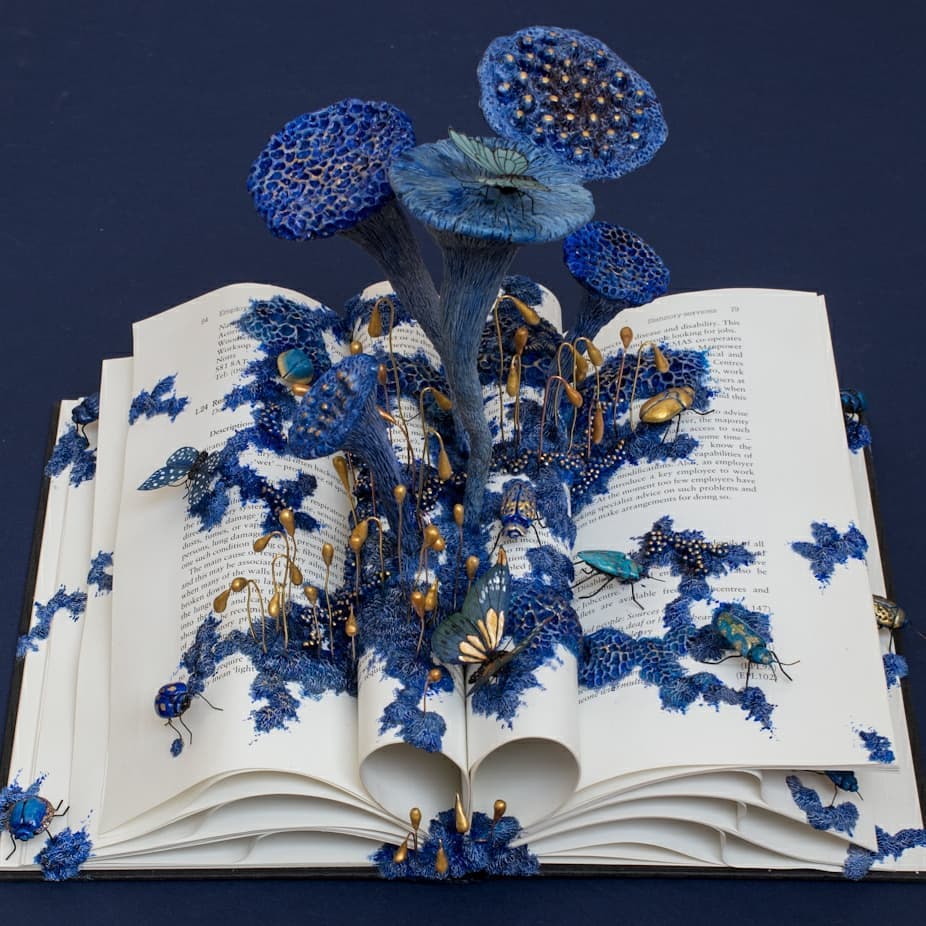
Next, we moved into sculpture with another French artist, Stéphanie Kilgast. Her environmentally-focused work is detail driven, and bursting with color.
And finally, we met choreographer-turned-costume designer Olga Saretsky, born in Kazakhstan, now creating breathtaking works in Miami.
As I look through my notes from this collection of conversations, I see SO many potential directions. All three of these artists talked at length about childhoods full of creative play and tinkering.
Weirdly (or maybe not at all), they also all spoke about remaining open-minded with regard to beauty, embracing or at least considering the “ugly” in various ways. Frankly, I’m tempted to focus today’s essay here, on this very juicy topic.
Alas, I’ve pre-committed to centering this season’s essays on my lessons. And the truth is, my lessons are elsewhere.
When I asked Elodie about her perfume school classmates, wondering whether perfumers are generally artistic people, or more like chemists, she told me her fellow perfumers “tend to also be creative in other ways.” She finds her peers to be, in her words, “dynamic, independent, and sensitive.”
These three adjectives didn’t strike me in the moment. They feel naturally-grouped in the context of artists.
Looking back though, I find it curious.
“Dynamic” calls to mind a certain type of person—someone bold and charismatic. There’s a bigness to it. An undeniability.
And while “independent” could suggest aloofness, it regardless implies power and sovereignty. It’s unfettered and unconfined, answering to no one. And again, there’s a bigness.
But I’m sure I’m not alone in feeling that “sensitive” conjures something else, entirely. She’s a delicate creature, maybe lamblike. She’s musing, and measured.
I’ve written a lot about the dynamism and independence of artists. I’ve certainly aimed to cultivate those traits in myself, and in my work, and have admired these characteristics in peers and mentors. But I’m not sure I’ve done justice to sensitivity. I’m not sure it’s something I’ve been taught to value.
Elodie tells me sensitivity is “a blessing and a curse,” but that ultimately, her sensitivity “is definitely a gift.” She says, “it’s a big part of why I’m good at what I do. Perfumery is that sensitivity.”
And I think I know exactly what Elodie means. I feel similarly. Though, I do think I’m deliberately prioritizing sensitivity in a new way. I’m honoring it and protecting it much more consciously. I’m looking under the hood.
And of course, there are so many ways to think about sensitivity.
There’s the sort of applied sensitivity Elodie alludes to, the literal sensitivity of her nose, or my ears; the interoceptive relationship I have with each component of my vocal mechanism; the sensitivity a chef has to salt, fat, acid, heat; or a dancer’s finely-tuned spatial awareness.
But there’s also the sensitivity of figurative taste, of discernment, the careful calibration of well-informed consumption.
As Stephanie puts it, “everyone has different sensitivities.” For example, Stephanie is naturally “good at colors” and has an intuitive knack for rendering fine detail in three dimensions. Stephanie’s musician boyfriend, on the other hand, is attuned to tonal complexity, and often finds himself captivated by the sort of subtle acoustic shifts Stephanie might struggle to detect. In turn, he is liable to overlook an exquisite patch of sculpted lichen creeping across one of Stephanie’s works.
She says, summing things up beautifully, “not everyone is going to see either my details or yours, but some will be touched by them.”
Stephanie points to an even more abstracted brand of sensitivity when she tells me about her first formal art class, held in the studio apartment home of a gifted teacher. The space was inspiring with a big wall of bookshelves, and an open area for teaching, easels in rows. Stephanie says, “the place felt amazing.” Right away, she knew.
Digging deeper still, elaborating on her creative process, Stephanie tells me she’s not much of a composer. Rather, she “tends to go more with the flow.” She says, “I don’t really want to think about it…my subconscious will figure it out.”
She wants to be clear though, her work isn’t surrealist, per se. In her words, “technically, surrealistic art is linked to dreams, and I’m not really into that way of working. I do tap into my subconscious, but it’s because I know it’s faster at analyzing things than my conscious brain.” She says, “most of the time it does work.” #rad
Olga describes something similar. She days, “it’s a combination of the feelings inside of me that inspire me to create…not so much of the visual.”
She tells me she usually doesn’t even draw or sketch anything before she begins to build a costume. She will have some kind of a vision for the piece and will just start making. “During the process, new shapes arise, details arise.” She says, “this is my favorite part of the whole creation—figuring it out on the spot.”
For Olga, “creating is so easy.” She has ideas five years ahead, “the visions just come.” Like so many artists (and like me), Olga has always had an abundant imagination, and a robust daydreaming habit.
She tells me her characters “come out whenever they can, whenever I can accommodate that coming out. I never take credit for this…I feel like it’s not even me making them. It’s just something coming through me and I’m just the messenger that will be able to bring them to life…it comes only from being present. That’s where the whole magic happens.”
Olga continues, “when you’re creating and you allow things to fall into place, this is being present. This is when the universe itself is using your hands to put something together.”
I’m so into this. It passes the gut check, and rings deeply true. An enchanting, enlivening cosmology. A delicious alchemical notion.
It occurs to me that perhaps this is the essential nature of art. Like an enzyme unfolds a trickly little protein packet, freeing its amino acids for absorption, the artist harnesses her one-of-a-kind passions and skills to craft a transformative conduit whereby indigestible “X” pours in from the ether and emerges as esculent “Y.”
In Elodie’s words, art “is to translate emotions into something, a medium or whatever it is you use to transmute, to share those emotions with other people.”
But really, it’s more than emotion. Elodie assembles molecules in a way that compels the smeller to recall something simultaneously ephemeral and pointedly, tangibly real. She formulates fragrances that trigger deep-seated sense memories of faraway places, or even moments in time. She creates a “multi-dimensional sensory experience for people.” It’s chemical, airborne worldbuilding.
Meanwhile, Olga “thinks in shapes,” catalyzing deep connection via abstract silhouettes, rousing a primal sort of freedom through the covering of faces. She’s learned from experience that masks yield reliably magical effects upon both their wearers and their viewers.
And Stephanie transmogrifies a planet-focused intention through color and form. Her work is “a reassuring reminder that nature has the capacity to grow back, if we only let it.”
This is her wholehearted, single-minded focus. She tells me, “it’s the problem of my life.”
I couldn’t love this more.
As I look back on my own artistic endeavors and consider the strings I’m pulling on at present, I can readily identify connection as the problem of my life. It’s my favorite puzzle. It’s at the heart of all of my projects. It’s the pulpy “stuff” of my queries and dreams.
Admittedly, my processes are in flux. My mediums continue to bewilder me. The means and mechanisms of this enterprise remain enigmatic. But I’m learning to let my subconscious do more of the work. And I think I’m moving in the right direction.
This feels like the right moment to tell you I’m decidedly about intuition lately. I’m looking it right in the eye. That is, inasmuch as one can look intuition in the eye, even proverbially.
What I mean is that I’m cultivating intentional practices around intuition. I’m turning the sensitivity dial all the way up and pumping the brakes on planning, projecting, and certainty. I’m eagerly expanding my metaphysical fluency, leaning liminal.
Can’t wait to see what lessons February has in store…
Happy Snow Moon!
Emily
P.S. Look at this GORGEOUS thing Stephanie made. 🤯