In my last Deep Dive (here), I shared my burgeoning theory that various archetypal creative behaviors might supersede medium as we seek to understand what it is that we’re doing when we make art.
It should come as no surprise that in addition to behaviors like worldbuilding and improvisation, many artists report self-expression as an overarching driver of their creative works.
Certainly, there is nuance here. Some artists use expression as an emotional regulation tool—they seem to literally need to move emotions through and out of their bodies via creative behaviors. I imagine this sort of valve-opening generally works just as well with or without an audience.
But I believe that many of us are pulled to share because we feel a deep, pressing need to be seen, understood, and valued in our unique authenticity.
All of my August guests spoke about this in different ways.
Briar says, “I had this need to stay hidden to stay safe…but then you begin to resent that. I’m not seen, nobody sees me. How do I survive? I need to be seen. But then if I’m seen, I’m not safe.”
This double-edged scenario rings true for many of us and is perhaps one reason to embrace abstraction in our creative offerings. Abstraction allows us to create from a truly vulnerable place, but to keep the work itself somewhat removed so it can’t be traced or translated back to the original impetus.
In Briar’s words, “it’s a way for me to express myself safely, but BIG.” She feels “at least seen by the paper.” This is so relatable to me.
For David, cutting through the noise is more of a draw.
Particularly in mediums with an institutionalized standard of excellence, the uniformity of “perfection” can feel antithetical to individuality. As David puts it, “something in me knew that I wasn’t gonna get out of here unscathed unless I didn’t let any of that get to me.”
David has built a beautiful career around his authenticity. In playing what/how is most natural to him, he finds himself straddling the often-fraught lines between classical and jazz, composition and improvisation, ensemble member and soloist in a way few musicians do – as it happens, no man’s land is frighteningly exposed.
But David has found this penchant for duality (or perhaps a radical acceptance of his own un-pin-down-ability) to be one of his greatest strengths, something he’s specifically sought out for by artists and institutions all across the spectrum. In David’s words, “for me, if I can tell my story as clearly as possible, it still has validity in all of this bombardment.”
I love the subtle twist of a third possibility Roxy lays out. In this case, the motive isn’t to be seen, but to see, though the result seems to come full circle.
In Roxy’s words, “I always wanted to take the ideas that were in my head and make them into a tangible item.”
I relate to this, as well. It’s vision!
And like Roxy, I feel grateful to have never been burdened by the idea that my creations are for anyone but myself.
But Roxy zooms out a step further in declaring that trying to please others “never pans out in a positive way.” She continues, “in my experience, you are taking something away from yourself, and it reflects in your art every time. If you aren’t deeply invested in it because you’re doing it for a different reason other than the fact that it moves you, or you’re passionate about it, people can tell.”
Of course, the implication is that the opposite holds true – that people can tell when you are creating from an authentic place.
I like the way this framing takes the focus off of the artist’s identity writ large, but highlights the artist’s commitment to following their muse, employing their unique skills and perspectives to do so.
And regardless of whether our unique skills and perspectives (and muses) are packaged up and defined as such, they sort of are our identities, sans finite identifiers. If you ask me, the job gets done just the same. Those who are able to see your work will see you, as well.
Or, at least, will see a bit of you in a sliver of time. After all, we each contain multitudes. And our landscapes are ever evolving.
I’m inclined to address a sticking point here, having observed a trend I find personally worrisome.
In our globally accessible digital environment, there is immense pressure to stand out, to niche down, to home in on a perfect cocktail of hashtags, to define ourselves as tightly we possibly can.
And I get it. Especially when your livelihood is on the line, you’ve got to do what you must to please the algorithm gods.
But I see increasing fragility around these pared-down, pinprick “authenticities.” I’ve seen it in my students, and amongst peers.
For those afflicted by this particular brand of scarcity, even consuming (let alone creating) something outside of their declared niche seems an existential threat – like giving up hard-earned battleground.
Creativity dies in that narrowness, as does connection. Frankly, I think audiences die here, too.
Wonderfully, my new friends had thoughts about this, as well.
David, officially the oldest Artifice guest to date (at eighty) said “usually I reinvent myself every ten, fifteen years…and I’m finding the same general direction of experimentation is still there.”
For David, it’s both, and. It’s regular reinvention with a throughline.
I LOVE hearing this from someone who’s lived twice as much life as I have.
Once again, Roxy applies the principle directly to her work. Throughout her life, she’s been drawn to mediums that allow both addition and subtraction.
It’s not necessarily unique per se – plenty of mediums (especially outside of the visual arts) allow for endless drafts and edits. But I have to say, the stakes do seem somehow higher for a tangible, physical medium. And in any case, I’m mostly moved by Roxy’s awareness of it, by her willingness to name and claim it.
For someone as powered by vision as Roxy is, I love that she knows she’s not going to reach her visions in a straight line. She’s gonna go too far, take a bit too much away, need to add materials back in, probably reduce again. There’s something fearless about it. It’s unprecious in the most precious way.
Like Roxy, Briar’s works remain “open” until she seals them. But Briar’s medium allows for much less control – the materials literally move themselves.
This fantastical process teaches Briar radical lessons about herself (more on this in a bit), but my heart splits open hearing her reflect on the parallels she sees in her children.
She tells them, “I don’t want you to ever dry. Just keep changing and growing.”
She tells me, “your love as a parent is to let them become who they’re gonna become.”
As a person working hard to kindly parent myself, I cherish these words from Briar. I hope to never let myself metaphorically dry. And I will always do what I can to create the kind of safety that allows those around me to “keep moving,” as well.
Throughout the past several years, I’ve written (and thought) a lot about the nature of identity and authenticity. I’m fascinated by the simultaneous ubiquity of myriad human traits, and our equally undeniable uniqueness. I love to examine frequent patterns alongside the inevitable outliers. And I find art to be a wonderful lens through which to examine each side of this coin.
But the truth is, this topic largely remains salient to me because I’m constantly searching for ways to better understand myself, where I might fit, where I might aim…
It’s tricky, man. Elusive and confusing.
I long to express parts of myself I haven’t been able to fully grasp, or develop.
And I do catch glimpses of pathways forward. I think I’m getting closer.
But I feel really strange about all of it. I’m pulling on strings, feeling around in the dark, trying to grasp something ephemeral. I sense that I’m working on something somehow unified, but I don’t know how each piece might puzzle together in the end.
Furthermore, while I’m pulled to share the treasures I discover along the way, I struggle to speak about them coherently independent of the broader context. And I’m not sure how to talk about the broader context without understanding each of its components, even ancillaries (after all, a side quest is sometimes the only way to get where you’re going).
It’s colossal, ineffably so. And it’s further obscured by its own (admittedly delicious) day-to-day minutia.
All this to say – I want to let you in on what I’m doing, but trying to figure out how to talk about it often leaves me feeling sheepish and exposed.
I worry it’s too much, too peculiar. Perhaps a little too much of myself, maybe entirely too much me. 🫣
Present fears notwithstanding, I’m buoyed by the words shared by my August guests.
David puts it simply (if bravely) when he says “I’ve always taken chances on trying to wade through the bullshit, to be who I am.”
When I asked him to share a dream collaboration, he told me he’d like to collaborate with “any genius who wants me to be me.”
Again, it’s simple. But there’s so much there for me. It’s a self-acceptance I haven’t yet found.
Briar echoes a few previous guests who’ve spoken about the way their work contains lessons they need to learn (and relearn). I’m moved by the way her medium mirrors her internal ecosystem in this way.
Even as a child, Briar found safety in “exactness.” That left-brained, admin-focused precision imparts a steadying sense of control, and Briar has always wielded these strengths easily, intuitively. They show up all over her life.
But Briar housed a secret wildness too, stirred by unexplored mystery, by oceans and galaxies.
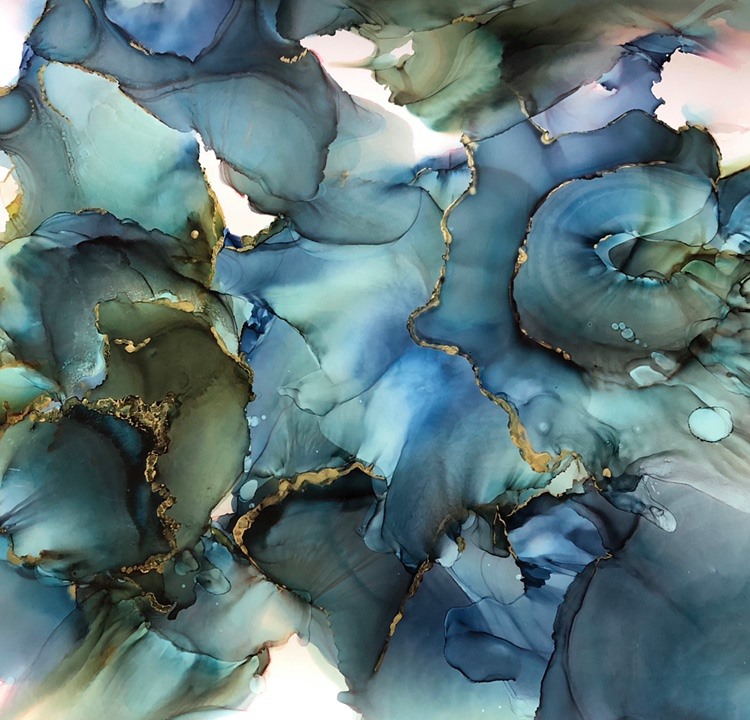
On a midnight whim, after decades spent tempering her more feral aptitudes, Briar discovered her medium pouring volatile fluids (bleach, alcohol, antifreeze) onto paper, in her words “forcing things that hate each other,” forcing her left brain to step aside, ceding control to something “reckless, chaotic, emotional.”
The chemical metaphor bares a sacred lesson for Briar. As currents and nebulae unfold across the canvas, Briar unlocks her own undomesticated parts, brimming as they are with beauty and power.
She gives them their place. Through this self-discovered work, her very own mad methodology, Briar balances herself.
Roxy, a lifelong maverick, knows it’s useless to attempt to “jam myself somewhere I don’t belong. I get myself pushed out.”
She talks about following her authentic nonconformity with increasing whimsy and glee. As a result, her particular art niche is “very specific to me.”
From my perspective, Roxy’s work is in every way a triumph. Fearless, and deeply inspiring. She sums it all up perfectly, “do your weird thing.”
I’ve had this phrase stuck in my head for months now. It’s delightfully undefined. Radically permissive.
At present, I find myself awash in all of these things. I ache to be seen, and to belong.
I want to safely inhabit my selfiest self, to realize visions large and small, to tell my story clearly, to keep following my wildest muses.
I’m learning to accept heavy losses. I’m slowly putting down shields. And I’m getting better at releasing expectations, and even some hopes.
I’m trying to embrace a more organic approach, simply allowing myself to do my weird thing freely.
Come what may…
Xoxo,
Emily
P.S. One of Briar’s rad pieces…