Oh my heavens. It’s somehow already mid-September and Artifice Season 12 is more than halfway launched into the world! Obviously, I’m entirely delinquent on my Deep Dives…
In my defense, it’s been my busiest wedding season to date. Luckily, my clients and their guests have been generally wonderful and it is deeply satisfying to provide meaningful, organized, well-paying work to my fellow musicians. Of course, the splendor of the wild American west is also its very own reward; this land has me in full swoon on the regular. Last year’s cross country pro tip still stands, never take a horse for granted.
We’ve also started a new semester at UVU, where I teach. I’m just teaching two classes this semester (Songwriting I, and a little vocal ensemble we call Studio Singers), but I’m feeling very creatively engaged with and heartened by both of them. My students seem so eager to learn!
And while I haven’t been keeping up on my Deep Dives, I HAVE been finding myself thoroughly moved while listening back to Episodes 211-219.
Throughout my recent travels, I’ve taken hard copies of my notes with me—pouring over them, looking for patterns, thinking about what I’d want to eventually write.
I’ve been consistent with this Deep Dive practice since late in 2019 – that’s FIFTY-TWO essays to date (I just counted and am feeling frankly 😳 at this number [shocked and bewildered]). But I have to tell you, something feels different to me this time around.
Last season (Season 11) included some fun bonus content to celebrate 200 episodes. In one of those special episodes, fan Jaron Davis interviewed me and asked about my favorite season of Artifice.
Honestly, the question totally stumped me. I hadn’t ever even thought about it! I’ve always considered each season to be a fairly random grouping of fifteen interviews.
Since I started the Deep Dive practice nearly six years ago, I’ve written an essay about every three episodes (the number of episodes released in one month), looking for commonalities among just those conversations, pulling in context from my present-day life as I search for interest and meaning.
I’d never considered zooming out farther.
If you look back at the Deep Dives from Season 11, you can see me starting to pull on this thread—starting to look for larger patterns. For Season 12, the thought has been salient from the jump. I’m completely intrigued. I can’t wait to see what lessons emerge.
But I can tell you that the up-front shift in perspective has already changed the game for me. Plenty of mystery remains, but I’d love to focus on a few things I’ve noticed so far…
First, and maybe primarily, I’ve just been completely blown over by the connections, themselves.
July featured reclaimed metal sculptor Stu Beavers, multi-media artist (paint, clay, prose, education, art therapy) Hanna Davidova, and wood sculptor Chad Pilkington. My heart felt full to bursting as I relistened to each of these conversations.
I loved learning about Stu’s insatiable desire for backstory, beginning with comic books found at flea markets during his childhood. Where did they come from? Where had they been? Naturally, he feels similarly about the recycled and reclaimed metal pieces (many of them easily 60 years old) with which he creates such beautiful works today. And of course, the same goes for people. Stu and I align on a favorite inquiry, “tell me more!”
It’s such a simple thing, but not in any way a given in a world increasingly defined by disconnect. As Stu puts it, “you have to try to figure out what you like, and a great way to do it is by talking to people.” << This idea that interests me more the more I think about it.
Hanna and I had so much working against us during our conversation. She’s a Ukrainian refugee currently living in Estonia. In addition to a pretty strong language barrier, we had a very difficult time with the internet, and lost each other several times throughout the conversation.
I nearly had tears in my eyes relistening—it was SO clear that we were both giving everything we had. Each time the digital connection broke, we’d come back in several minutes later both hanging on to the EXACT thought we were in the middle of when we’d lost contact. I feel so proud of us. 😭 And so tender! We both came to the conversation with complete earnestness and vulnerability. It’s genuinely precious to me. Pure magic.
At one point, I asked Hanna how she decides what to paint/make, and she said she tries all sorts of things as “experimentation for understanding other people.” In other words, when Hanna observes what people respond to, she finds she knows them better. And she sends out all sorts of offerings in hopes of finding as many connections as she can.
Like Stu (and like me), Chad loves talking to strangers.
I didn’t take down any specific quotes (and it’s now been months since I relistened to our chat), but I remember such a bright energy with regard to the connection. It felt clear to me that Chad hadn’t been asked much to talk about the ins and outs of his creative origin story, and he was SO eager to share. I remember him saying something like “so, we’re gonna do this once a month, right?” There was so much he wanted to tell me.
It means THE WORLD to me to get to capture a bit of what creativity and art-making means to those who create. And it means the world to me when artists are willing to give me their stories, to connect with me in this sweet way.
It goes beyond just agreeing to be a guest on a podcast. I’ve certainly interviewed some people who don’t seem to have any interest in connecting; they’re interested in a sort of sterile self-promotion, a terse, guarded storytelling.
Increasingly, I don’t have any interest in that. I’m in it for the humanity. I’m here for the connection itself. Art is the subject matter. Connection is the medium. And really, they belong all tangled up together. What is art if not a conduit for connection?
Shifting gears a bit here…
If you’ve been paying attention for any length of time, you’ll know that Artifice has led me to a profound confusion about the nature of medium (check the Deep Dive archives for more). What we’re doing is much too big, simultaneously much too bespoke, to smoosh into tidy boxes like “painter,” “poet,” “pianist.”
I want to say the grain of a new theory emerged when sculptor Jordan Sprigg (Ep. 177) described his process with an eerie similarity to jazz improvisation…
It made me think – with all of the different mediums in which we’re creating, surely many of us are composers, and many of us are improvisers. Of course, by now I know better than to imagine anything as a simple binary. Rather, this revelation encouraged me to look for more of these archetypal creative behaviors.
Over forty conversations later, I’m ready to let you in on this line of inquiry. Worldbuilding seems a common motivation/behavior for artists in all sorts of mediums. I’ve also heard a lot of artists talk about an archiving, chronicling, collecting sort of thing (I’m very intrigued by this idea). Attention to fine detail is an oft-reported enchantment, as is a tactile, “under the fingers,” hands-specific phenomenon. Many possibilities have emerged, but to date, I haven’t kept any formal lists, though I think it’s time to start.
Let’s start with Stu!
Over the years, I’ve heard SO many artists talk about loving a project. It emerges so frequently, I simply have to notice it. The desire seems mostly detached from any particular medium. It seems to include an obsessive quality—the project is our favorite thing to think about and we will think about it as often as possible until it’s completed, the vision realized.
I love asking artists to reflect on what makes them feel most creatively alive in the present, then inviting them to share anything and everything that gave them the same feeling at earlier points in their lives.
As a decidedly uncoordinated, nonathletic individual, I’ve often felt taken aback, confused, to hear artists answer with various sporty activities. I simply cannot relate.
But when Stu started talking about skateboarding, I recognized it immediately – for Stu, learning a new trick was a project! Something to be in love with, something to obsess over, something to chip away at. Suddenly, I can relate. Suddenly, we are once again the same.
Stu also talked about skateboarding being an early workshop for style, finesse – an obvious crossover into art territory.
Similarly (but also, not at all), Chad mentioned a creative spark igniting on the racquetball court. But for Chad, the creativity lives in the reaction. “Your brain has to react in within a split second. And you have so many choices to make.”
Ok. I’m going to have to drop a little Season 13 spoiler here because it’s just too spooky not to share…
Literally THE SAME DAY I relistened to my interview with Chad (completely having forgotten about the racquetball topic), I had interviewed winemaker Connor Book.
Get this, fam. Connor ALSO talked about the creativity of reaction. And GET THIS, FAM…he first mentioned it in the context of hockey, having been a goalie all throughout his teens (bizarrely, just like Stu, Connor also mentioned style as an integral component of his love of goalie-ing 👀).
But later in our conversation, when I was asking Connor what he loves most about making wine, he once again pointed to the creativity of reaction as a main draw—pivoting in response to nature (i.e. the amount of rainfall, the acidity of the soil), making small adjustments to the fermentation process based on the ephemeral, molecular qualities of each year’s grapes, etc.
Just a note here…there’s something so delicious about this link between the split-second reaction of a flying puck (or racquetball) and the years-long viticulture and winemaking process. I would never have guessed that these two mediums ultimately come with the same draw for Connor.
If I hadn’t sat down to relisten to the Chad episode in such close proximity to recording the Connor episode, I don’t think I would have noticed this at all. Again, probably because I can’t personally relate to this “reaction” thing they both love, I wouldn’t have clocked it. But there it was, plain as day. Another archetype.
I’m pleased to say, I’ve since heard this one repeated at least a few more times in more recent interviews and in “in the wild” conversations. I know now to listen for it.
You can expect me to continue collecting archetypal art-making behaviors for the foreseeable future. I’m not sure where this particular string-pull will end, but my interest is decidedly piqued by the seeming fundamentality of it.
Pivoting once more…
I have to tell you I’ve been really puzzling about how to wrap up this inaugural Season 12 Deep Dive. I haven’t quite figured out how to reconcile my frontal lobe with my gut instinct here. I’m not sure how to integrate my notes with my intuition.
Way back in January, I titled my first Season 11 Deep Dive “Joy is a Serious Subject.” Today, I find myself reflecting on the way this idea has rooted and grown within me throughout the year.
In so many ways, I’ve been all at sea. I’ve been searching for fresh starts, for firm, fertile ground upon which to build a more abundant home for my work, my longing, my stories.
I get confused about labor. I love to work. I love a project! I love a paradigm shift. Rigor ignites me in so many ways.
At the same time, I often resent others’ interpretations of my labor, their assumptions about my motivation or my goals. I feel an increasing need to eschew the insidious brand of “work before play” exalted in my childhood home. Invariably, work eats play from the inside out and sneaks around wearing her clothing. Long suffering becomes an ultimate point of pride.
To me, it’s a hollow mythology. A quaggy, spoiling bedrock.
And I hear it worming around in art spaces, too.
I think we lose the forest for the trees when we frame our commitments with this kind of capitalistic sterility, as if the grind itself is some sort of atonement.
We like to hear and tell stories about bootstraps and labor and various backbreakings and heartbreakings. And of course there are those. But I think we only take them on, or survive them, because ultimately the joy is bigger. Even the promise of joy is bigger (again, we call this “vision”).
Our motivation is self-contained, self-propelled, and renewable when we draw it from our purest inner wellspring.
Frankly, I believe most artists must learn to prioritize satisfaction, whimsy, bliss in order to do what we do. We have to learn and relearn to listen to that joyful voice, the most unassuming muse.
It’s simple. But it’s not obvious.
I empathize with Hanna’s story of losing her creative spark amidst an ongoing barrage of criticism and undervaluing. And I empathize with her when she says, “right now I am in the process of come back and take it!” I love the way this wording lands in English. It becomes a challenging little invitation in the most delightful way.
And why must Hanna come back and take her creativity? In her words “it heals. This knowledge helps me come back to myself.”
I can hardly imagine anything more powerful. It helps me come back to myself.
As Chad puts it, “creativity is just doing it how it makes sense to me. Creative thinking goes to fixing a problem at work, playing a sport, getting something done that you want to do or have to do. Whatever it is, you take a creative approach.”
You come back to yourself when you permit yourself to do what makes sense to you, when you permit yourself to create the approach that most satisfies you.
Though he’s been honing his creative skills throughout his life, Chad picked up artmaking for the first time during quarantine. As he tells it, he did “everything wrong”. He chose the most temperamental woods. He handled them in all of the most difficult ways. At every step he toiled… but joyfully, if painstakingly. Chad’s path was the one most forbidden by those with knowhow, but all the same, held least resistance for Chad.
And when Chad started winning fine art competitions and learning to accurately price his pieces for galleries, he marveled “it’s hard to value something when you don’t consider it work.”
But of course, there was work. It was work moved by joy.
In Stu’s words, “I think it’s just a satisfaction thing. When you have something that’s finished, or even partially finished, you can kind of sit back and look at it like – wow, I can’t believe I just did that. That’s really cool.”
This is how I like to feel. It’s how I do feel about so many things – about these gorgeous connections, about all of the little strings I’m pulling on, about all of my projects, each one filled to the brim with promise and mystery. I see them all this way. I’m committed to them in this way.
As Stu says, “we all have our little loves, and we need it. And what else would you be doing anyway?”
One more time.
We need it. And what else would you be doing anyway? 🧐
That’s all for now.
Xoxo,
Emily
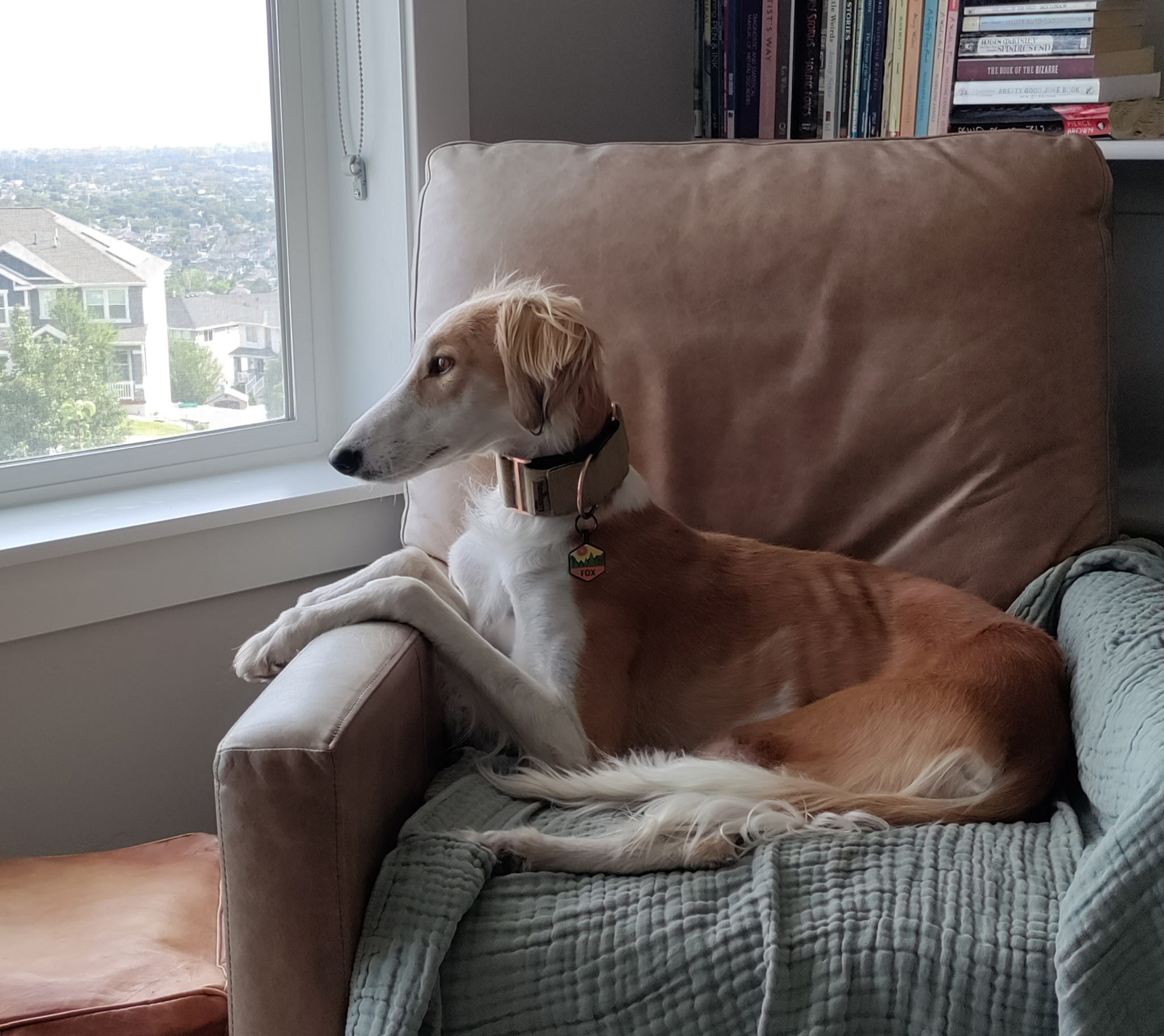
P.S. An update on another little love. Darling Fox has us utterly smitten. She is the most magical being.