Welcome to fall, all!
Last week, I had the rare joy of catching up with my childhood friend Drew, a fellow artist. He was sort of thinking out loud about the head-scratching heartache of trying to convince others (particularly gatekeepers) that your work is worth looking at. Of course, it’s something I understand all too well.
We commiserated a bit about how we’ve leaned into all of the tried-and-true marketing guru advice with nary a flutter of the proverbial needle. Then Drew said something I haven’t been able to get out of my head: “they haven’t seen this before.” This thing I’ve made doesn’t read when jammed into a standard envelope. Try as I may to get on and stay on the map, I keep finding myself off-road (full credit to Drew for this analogy).
But like…for real, though. What’s an Emily or a Drew to do if we may in fact simply not be made for existing maps? It’s one thing to make magic with what you already have (a la July’s Deep Dive), but it’s another thing entirely to gather up your magic and chart a brand-new path, brambles, thickets, and crags abounding.
Naturally, I’m looking for answers in this month’s episodes.
September guest, choreographer Kitty McNamee, always felt like a misfit, a “changeling” in her family. As she grew, she did her best to put herself in rooms that felt closer to right, but she continued to feel like nothing quite clicked.
I loved hearing Kitty describe how she began to navigate her own uncharted course. She tells me, “I activated the world around me and made it magical.”
With far less experience than her counterparts, Kitty started her own dance company just out of school. When asked whether she was worried about the competition, she said “no – because I don’t have what they have. I can only do what I do.”
Kitty worked her magic in the ways she could, where she could, and she felt her various projects feeding each other. She made a habit of looking for depth and plumbing it faithfully, “continually understanding more.”
And all of this divergence allowed Kitty to lead her company in brilliant new ways she hadn’t seen modelled. She says, “a big component of it is honoring who you have with you and seeing who they are, not trying to make them into who you are, but honoring who they are. It’s a good thing to do, and it’s also a smart thing to do…you have to look at [people] in a rich way and imagine them having depth…actively try not to judge them, accept them for who they are.” She tells me, “to be generative in that way is really nice.”
This all rings true to me in a way that sort of makes me weepy. The bravery of it astounds me. The boldness of it astounds me. The ownership astounds me.
Kitty draws from her bounteous internal resources, then enacts her map-less magic on the people around her, on the rooms she’s in. They feel it. And they respond.
I think I’ve been attempting similar things over the years, but I haven’t had the confidence Kitty describes. Like I mentioned in last month’s Deep Dive, I think I’ve been waiting for someone on the outside to see me and tell me I exist. As the analogy goes, it’s almost like I’ve been waiting for someone to extend the map around me and say, “you are here.”
It feels so clear to me that Kitty has spent decades standing her ground and saying out loud – I am HERE! And you are here with me, too.
I want to try that.
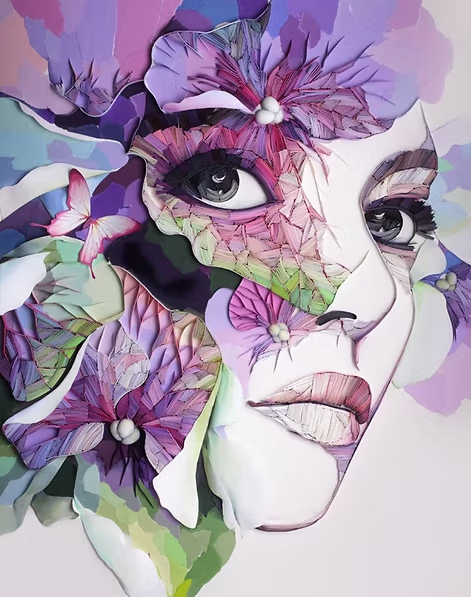
I’m moved by the graceful way paper artist Yulia Brodskaya navigates her maplessness, as well.
Like Kitty, Yulia knew from a young age that she was just a bit different than her peers. Her parents say she never used vivid colors in her childhood drawings. She was seeing the world in realism, even then.
She tells me, “I saw everything being more complex. I couldn’t bring down objects to just one particular color. And even if you have a red bowl, if you really observe it…there’s so many nuances. And I think the more you can observe and see them, the more chance you have to translate it through the medium that you’re using. Because if you notice something and absorb the information, you have at least a chance.”
I love the way Yulia talks about combining a rough plan with moment-to-moment intuition. She says, “when you make a sketch, it’s like you have a map and you want to hike a mountain. And there are multiple different pathways that are leading to the same peak…you have the direction you’re going, but each step is completely unpredictable. But because you have a map, you still follow the directions. You won’t go completely astray.”
Listen, I’m realizing in this moment that the map analogies are getting a little blurry here, but the way I read it, Yulia’s map+mountain analogy hinges on the phrase “you have the direction you’re going, but each step is completely unpredictable.”
There is no map showing you exactly how to climb the mountain. You just know in which direction you’re heading, and you’re going to put one foot in front of the other in whatever way you can find to keep climbing up.
Critically, in Yulia’s analogy, the map is indeed her very own work, as well. The destination itself is conjured from within, as is the persistent tug toward that arrival point. And the compass is also there, deeper still.
She says, “you have to drop into your heart center. Somewhere down. I experience what is in front of me from there…to feel, you need to send the elevator down.”
To make those moment-to-moment decisions, to route your way up the mountain, you have to send the elevator down. You have to trust your deep intuition – no small feat for a timid overthinker.
I hope Yulia will forgive me if I’ve gotten this wrong, but I think she and I share a bit more fear and reservation than what I feel from Kitty (although, it may just be that Kitty has lived more life than either Yulia or I). Regardless, I’m inspired by the way Yulia talks about managing some of those more shadowy obstacles.
Even when wrapped in dread, Yulia knows “you don’t say no when the door opens.” You’ve got to be willing to move, ready or not.
You’ve got to be able to pivot, to update, to refocus in the face of new information, or a shifting status quo. In Yulia’s words “from the limitation that I said to myself initially, I kind of set myself free.” <<< 🔥
And you’ve got to deal with your demons. You don’t get to choose which of your parts comes with you into your art-making.
As Yulia puts it, “you become a better artist through becoming a better human being, or a better person…the more you clear, the more you work on your stuff, it all just shows up in the art. Art teaches me a lot of life lessons – how to be present, how to see things, just how the tapestry weaves itself and what you do from this ‘now’ place…my life and my art process, they’re very interwoven now.”
I’m working so hard on these things.
Poet Lee Woodman also sees art as inextricable from life. She tells me, “all of your senses feed your creativity…you can’t just depend on your ears or the places you’re in to understand things. You have to give your total body to it.”
Now, I know that last sentence is straight fire and can absolutely stand on its own, but I can’t gloss over it. If I’ve learned one thing so far during this, the year of being about the business of healing my fucking nervous system, it’s that I don’t think I’ve ever given my total body to anything. I haven’t ever been all the way inside my body in the first place. I don’t think I’ve ever owned my body enough to give it to anything.
But I’ll tell you, I think I’m getting there. I’ve felt a few flickers of deeply embodied self-ownership in the past couple of weeks. And it’s making room for these lessons to land in a new way.
Lee’s lesson builds beautifully upon Kitty’s action-forward savvy and Yulia’s elastic discernment.
Like so many of the artists who inspire me, Lee moved through myriad careers and subjects over the course of her life, finally digging into her primary medium in her mid-sixties. I think I yearn for this kind of story because I have the distinct sense (as I’m literally always saying) that I’m not sure where I’m headed. And I’m on the lookout for guidance.
Toward the end of our conversation, I asked Lee to look back and consider whether she took each new step at face value, thinking something like “this is interesting, maybe I’ll go here now,” or whether she was sensing a longer pull toward something in the distant future.
In response, Lee rattled off an outstanding list of pivots through which she followed her curiosity, followed her passion. She sums up, “looking back, it was absolutely a straight line, but going from the bottom towards now, it was curvy, curvy, curvy.”
Lee highlights the importance of her own “willingness to make changes,” and makes it clear there were real risks involved. She tells me, “I took that chance of, you know, not even going parallel, but taking a step down to move up. And it always worked out, you know? People would say to me, ‘well, you know you’re not going to be a producer here. You’re going to be a production assistant.’ And I would say to myself, ‘just wait and see.’”
I can’t tell you how much I love this. Just wait and see. Just watch me blow your entire mind.
Lee has lived her life open to surprise, open to wild and unexpected success. I feel such joyful power in it.
While Lee didn’t explicitly apply this next bit to her career trajectory, I’m inclined to draw one more line, here.
Transformation was a consistent theme throughout our conversation. Lee speaks about it with a kind of reverence I find immensely compelling. It’s a blend of mysticism and realism I can’t quite put my finger on.
As I understand it, Lee sees transformation as gradient from one motion to the next. She tracks the small, subtle changes that result in a dramatically different A and B. This is not a snap-of-the-finger metamorphosis, no lightning bolt, no cloud of smoke. It’s almost mathematical, a one-degree shift of the vector. Or maybe it’s like Yulia’s red bowl, so bluntly real you almost can’t see it.
At the same time, it’s divination. It’s closing the eyes entirely, sending that elevator all the way down, and shifting weight ever so slightly toward the faintest whispers from the void—existing wholly and confidently in surrendered liminality, at once unmoored and grounded. It’s the lived-in space between that straight line and the one that’s curvy, curvy, curvy.
As our map analogy goes, it’s maybe an invisible ink situation. The map is there, and you’re on it, but you can’t read it with any of the standard tools.
I know Lee feels this way about her poems, but I find myself wondering whether her career pivots felt this way, too. If perhaps what looked like a major move from the outside (or on a resume) was indeed the result of a gentle gradient, dramatic transformation by smallest degrees.
I do hope so. And I hope I’m living a similar type of surrender. I’m eased by the idea that my big transformations will arrive softly in this way, that I can transform myself via daily minutia, that trusting my mundane joys and instincts will yield magical results, that I needn’t enact a violent about-face to get where I’m going (indeed, violence feels counter to the soothing of my sparky synapses).
All this to say, I welcome a productive softness, a purposeful meandering.
I welcome a rough sketch and a heart-centered flexibility.
I welcome activated divergence.
To pull it all the way back home, perhaps the crux of the thing is that, gatekeepers aside, I haven’t seen myself before. I don’t know precisely where I’m headed because I’ve yet to see a model of my highest self in the world. I’ve got to blaze it, build it, conjure it as I go.
That’s all for now, darlings! I’ll be back in November for our penultimate Season 14 Deep Dive.
Happy existential off-roading to all fellow spiritual AVS.
Love,
Emily
P.S. Look at this gorgeous thing Yulia made. Guys, this is PAPER. Like folded and glued upright. Quill-maxxing.