Believe it or not, here we are at the near close of another year. I entered 2026 with an extra helping of earnestness. I was more ready than ever before to learn some new lessons, escape some tired patterns, and perhaps welcome some kind of timeline shift, a lil quantum leap, if you please.
Especially if we’re looking toward the lunar new year (which I’ve learned I very enjoy), there is still a full season of this chapter ahead, and therefore, hopefully, a bit more to wrap up and discover. Nevertheless, I do find myself having entered this year’s reflection phase. I’m feeling the beginning of this particular end.
On that note, allow me to share a core memory.
When I was in the second grade, my class welcomed an East Asian student in the middle of the semester. Naturally, our teacher encouraged us to take special care to make sure our new classmate was welcomed and integrated.
I have a particularly vivid memory of an intimate, morning recess swing set chat involving new student Mae and a small handful of other girls from our class. I really can’t emphasize enough how homogenous my school was at that time, but suffice it to say, we were beyond intrigued by the idea that Mae was not only not Mormon, but also not any kind of Christian. It was truly anomalous.
I remember this group of us peppering Mae with questions and—as the Mormon vernacular goes—bearing our baby testimonies of Joseph Smith et al. 👀 Absolutely burned into my brain is Mae, literally 7yo wtf, saying “that’s your truth, that’s not my truth.”
It was like one of those movie scenes where the POV camera kind of zooms back and the images and sounds go blurry. The other girls kept chatting, but my little self had gone inward, struck as I was by what Mae had said.
I remember being totally rocked by the idea. I think I sort of liked the expansiveness of it? I definitely liked that Mae had said it, and so confidently. But I also felt bewildered and confused. I remember my little brain gears grinding and just thinking…no. Either what I believe is true, or it’s not. It can’t be conditional to the individual experiencing the belief.
Of course, my adult cognition allows for more nuance, but I largely feel the same way as my baby self did—that there are immutable (if unknowable) truths that apply equally to all of us, that mutually exclusive truths cannot coexist.
Though, at present, I generally feel that any kind of cosmic certainty is beside the point if what we’re looking for is insight on how to live our lives.
Our lived humanities present us with infinite varieties of resources, interests, desires, influences, strengths, limitations, traumas, obstacles, etc. We’re each allowed our own understanding of a life well lived. And we’re each presented with a bespoke puzzle as we assess where we are, what we have, and where we’d like to go.
Still, those unknowable cosmic somethings do often seem to be hovering around, affecting us in spooky ways.
I think this is what October guest Jonathän Jouan means when he says “invisible things are part of the truth.” Like – regardless of whether they’re in your conscious awareness or understanding, these mysteries are present, and they’re detectable. They’re in the room with you.
That said, I do think some of us are more sensitive to (preoccupied by?) these invisible truth-components than others. We feel them. Unmistakably. Ignoring them is simply not feasible.
For a child, this can be quite the predicament. These intuitions and instincts are there in our fledgling frames, but if our environments aren’t exposing us to language or philosophies that support our wee inklings, we’re left hungry and hollow, our proverbial periscopes aloft and alert.
Jonathän talks about leaning toward Greek mythology for role models he felt missing in his childhood. Having recorded over 250 artist interviews, I can tell you this is common amongst creatives. My gut says it’s indicative of the aforementioned achy awareness of a particular branch of ever-present, invisible truth our caretakers and peers won’t or can’t acknowledge.
We feel psychic archetypes in the world around us and find them elucidated in these ancient stories, readily available to many children. However fantastical, these stories are somehow more honest than whatever else we’re encountering. They speak to the parts of us that yearn for deeper understanding. They offer clues toward our individual growth instinct—those little corners of the “big T” truth most relevant to each separate being.
I like the idea that another of Jonathän’s personal invisible things is an innate reverence for objects. As a child, he was introduced to the existence of Fabergé eggs and was immediately enchanted. Something in his little soul sprang up and cried out.
I like to imagine this particular ache leading Jonathän step by step to Japanese philosophy, first via manga, then steadily to Shintoism, and forward from there.
The story of the Tengu (Yokai-turned-Kami :: demon-turned-protector) inspired one of Jonathän’s first professional works, helping him discover and build the philosophy he creates within today. He aims to create “a shell for a soul,” telling me “I’m just a shell builder…and through the ages when time will pass, a soul will go into it.”
Do you see what I mean? This is the growth instinct I’m talking about. It’s not mine, it’s not yours, it’s Jonathän’s.
And there’s more.
I felt totally giddy hearing Jonathän talk about how he started his current series. He’d decided to focus on rye straw marquetry as his primary modality, and found himself snooping around the interwebs for pieces of a puzzle he felt but couldn’t quite see yet.
He tells me he came across the work of a biologist studying a subset of amoebas that harvest silica from soil to create a protective shell for themselves. Beautifully, this is what rye straw does, as well! The silica is what gives rye straw its famous shine, allowing it to interact with light in a truly remarkable way.
Having discovered this symbolic, spiritual link, Jonathän was able to build out a gorgeous mythology using rye straw “scales” as the medium, and predatory mega amoebas (google tells me that shelled, “testate” amoebas are the apex predators of the amoeba world #funfact) as the subject matter.
The mythology gives Jonathän a playground wherein to explore the medium fully via loosely contained iteration, and lets him explore his other growth instincts (storytelling, worldbuilding, a sort of folkloric anthropology) in the same flexible container.
Reader, I submit to you that this is divination. In lieu of cosmic transparency, Jonathän has developed a wonderfully personalized, sustainable method for examining the invisible things he’s drawn to. He’s found a way to discover the parcels of truth he longs for—the parcels of truth his progress demands—without needing to tease apart the entire matrix.
In lieu of cosmic transparency, all any of us can do is try to develop tools and methods to better discover, understand and interpret the invisible presences that linger on the fringes of our individual awarenesses. We craft our made-to-measure divination systems to illuminate the truth grains we most need to do whatever we must do.
Now, you may be thinking – Emily, don’t you always write these essays on a single topic addressed by all three featured guests of the given month? How are you possibly going to thread this needle?
To which I say IT IS NOT EVEN HARD because believe it or not, my second October guest, author J. Timothy Hunt ALSO talked about hidden truths and systems whereby they may be unveiled. 🤯😭 Like I’m sorry what is happening.
Like Jonathän, Timothy was drawn to Greek mythology as a child. The models he found there helped him begin to sort through the cognitive dissonance of being raised in an abusive home where fundamentalist Christianity was the only lens allowed.
Having had a similar childhood experience, I believe this kind of dissonance is a growth instinct, as well. A gnawing sense that mountains of truth are being hidden from you.
I couldn’t say for certain whether it’s related, but I’m struck by another trait Timothy and I share. He tells me he “can’t lie” to himself or others. His integrity is too strong.
I’ve heard lots of artists say similar things in various contexts, but this time I’m finding myself wondering whether unyielding honesty is another way to cope with these weighty, invisible things—some kind of internal commitment to avoid participating in further confusion or fraudulence. No part of the truth will be hidden on my account.
Even so, survival often necessitates that we hide things from ourselves. These invisible things are particularly insidious, buried in our cells, sequestered in our remotest gray matter, internal exiles we haven’t a direct way to confront or absolve.
Timothy tells me his artistry was “just shut down…the well had been locked down and sealed shut for decades and decades and decades. So, I’m just now looking down into the pit and seeing all of the things that I let go or repressed.”
I relate deeply, as these many years of essays regularly indicate. And as I set out bushy-tailed at the top of this year, I couldn’t have foreseen that so many of 2026’s discoveries would feel like monsters crawling out of that inky well.
Harrowing as these processes are, I ultimately welcome them, as any seeker of hidden things must. As Timothy puts it, “I’ve exorcised so many demons now, I can’t wait to see what I’m free to do next.” 🔥
And that’s really the thing, isn’t it? There are monsters in the pit, but we won’t be surprised if a Pegasus flies out of there, too. Those are the beautiful, powerful things we “let go or repressed” alongside the monsters. At least, that’s how I read it.
Because while Timothy experiences periodic flashes of repressed horrors, demons yet to be exorcised (#ptsd), he’s of course always also had flashes of freedom, of those magnificent flying things. He felt them in the old Greek stories, in scripts and roles, and behind his pen. And he’s wielded those flashes toward the discovery of reliable methods for opening his internal well, along with plenty of other channels.
He tells me, “I had little epiphanies, moments where I was just struck with a creative force sort of outside of myself. And then I just didn’t ignore it.” Discipline is one of Timothy’s tools for capturing those flashes—those invisible, ephemeral things made known, if fleetingly.
Discipline is also a crucial element of another of Timothy’s methods, an unrelenting journal habit. In his words, “by doing all of this journaling, I’m training these muscles…I just keep the pen moving and keep connecting my thoughts to paper.” Timothy tells me he doesn’t get writer’s block. Not ever.
“Just walking down the street, I’m writing.” He’s always, always open. He says, “sometimes you have to let go to receive it.”
If this isn’t claircognizance, I don’t know what is.
Now, I’m inclined to pause here and tell you that of course this essay practice is one of my best divination tools. When I say I look for my lessons here, this is what I mean.
And it is mysterious to me.
Looking at it now, it seems plain as day that all three of my October interviews share this same esoteric subject matter. But I’ll tell you, I couldn’t see it at first. I couldn’t see it for weeks! Not while looking at the exact same printed out notes. Not while asking the same questions over, and over again. And I would never have seen it without Keith, October’s final guest. The key was in the Keith notes.
And actually, this nugget from Keith, this thing that turned out to be a key, really leapt out at me during our conversation back in April. It’s lingered with me all summer. I didn’t need to wait for the six-months-later relisten to know it would be there waiting for me.
Keith told me that as a young person, he was kind of obsessed with saving money. It assuaged his anxiety about ever being tied down or stuck somewhere he knew he shouldn’t be.
The need for independence is a critical component of Keith’s creative potential, and it’s therefore phenomenally important to Keith to never be trapped. He knows that in order to have the luxury to explore, he needs flexibility, and he need resources.
It’s a little thing, really. But it felt huge to me.
The way Keith talked about this saving habit felt eerily familiar to me, though I’d always assumed that my penny pinching was about being free to escape my abusive family, something Keith and I do not share in common.
It occurred to me for the first time during our conversation that perhaps this characteristic could be one that’s inherently mine, not a survival strategy. This idea rattles me, and sort of thrills me, too. It’s been sitting on the edge of my mind ever since.
I’m not yet confident enough about what it means to say more, but it feels big. Consequential. Maybe a vital cog in my quantum leap apparatus? In any case, I’ve got my eye on it.
Ok. I’m going to set this thread down for now and pick it up a bit later…
Back to Keith.
We talked about this freedom thing for so long, nearly the entire interview. It kept coming back in new ways, in new chapters. Keith describes himself as never having had a problem leaving a job or situation that didn’t bring him joy or satisfaction. And it shows in the story.
But right as we landed on Keith’s current chapter, an abrupt shift whipped my head around completely. As Keith introduced every meticulous component of his present-day creative ecosystem, all I could hear was a soul-deep comfort in the obsessive-compulsive control of each element.
Naturally, I pressed him. “Hold on, Keith. What are you telling me, here? You’re all about freedom and flexibility, then suddenly spouting love letters to your rigidity?!” 😅
Keith was so calm. He just chuckled and told me he doesn’t totally understand it. All he knows is that he’s learned to build out each painstakingly perfect branch of this categorically exquisite system, and that its gift to him is “freedom from my own brain.”
As it turns out, once Keith discovered a project that felt like home, uncompromising structure became an unlikely hero, vanquishing the final boss, allowing Keith to access his best, freest magic.
Now, here’s where I return to that loose thread and take you behind the scenes of some of my best magic…
My Deep Dive method is always to print out my notes from all three interviews, then stare at them, ballpoint pen in hand, underlining, circling, starring, and scrawling unhinged notes in the margins. Usually, a pattern will emerge.
In this case, I’d highlighted Jonathän’s invisible things quote early on, drawn to it as I am. My gut said it was a perfect umbrella for this essay. Maybe the title. And I’d clocked that each of my three guests had spoken about the systems they’d created for themselves. But I wasn’t sure exactly how to connect these dots.
My margin scribbles include “is the need for freedom the invisible thing?” And “truth in a manageable container?” And “link b/w mystery (freedom) + making (system)?”
The pieces were there, but the connective tissue refused to materialize.
I’d look at my notes every few days hoping something new would jump out at me. When weeks went by sans lightbulb, I had to turn my focus inward. I had to look myself in the eye and remember wtf it is that I’m doing here.
I’m not here to pontificate on this, that, and the other—whatever clever throughline I can whip up to satisfy a totally arbitrary deadline (this is homework I give myself, and I do know that). I’m here to look for my lessons. And of course, Keith’s penny-pinching freedom lesson was the one that had hit me hardest.
Just like that, I realized the answer was right there in front of me.
I don’t know that I was totally ready to admit it until that exact moment, but as I’ve already told you here, this practice (the interviews, the notes, the essays) has become an irreplaceable, truly precious divination technique for me. It helps me find the hidden things my personal cosmology requires.
Letting myself lean into that magic, letting myself prioritize the lesson I most needed to receive—that a pull toward freedom could be an essential ingredient of my being, not a byproduct of the structures that harmed me—allowed me to see that frugality didn’t need to be a throughline for this lesson to be the throughline.
Each of my guests had shared a hidden-thing-capture method of their own, but I had to be willing to acknowledge the power of my own spooky system before I could see that this is what all four of us are doing. It’s a namaste moment. And the motif is magic itself.
It’s so tender, I could cry.
Alright, darlings! I’ll be back in December for the final Season 14 Deep Dive. There’s been an awful lot of enchantment in the mix so far. I can’t wait to see what lessons are waiting for me in this last chapter…
Happy Seeking!
Emily
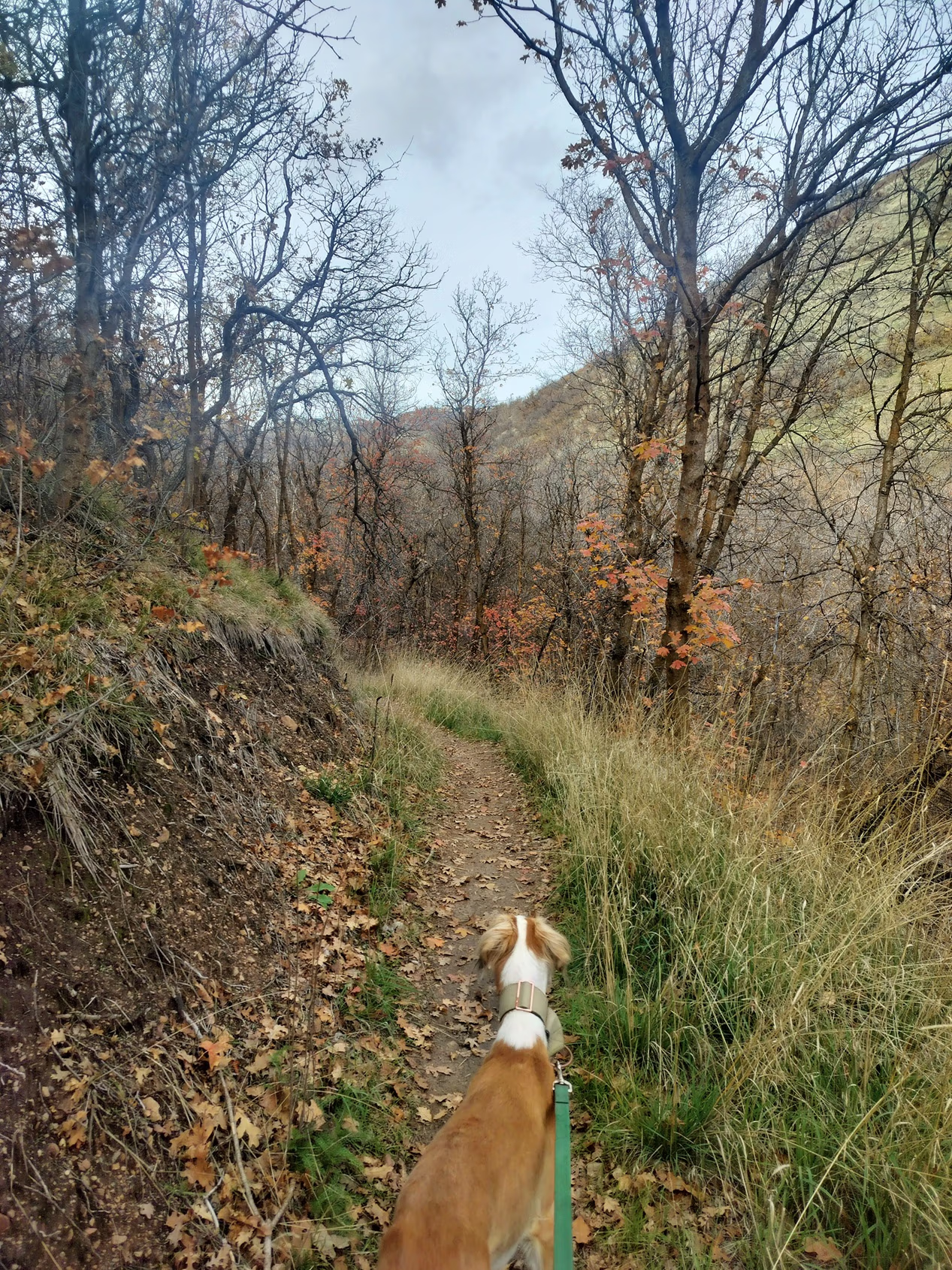
P.S. A picture of my sweetie Fox from yesterday’s fall adventure 🦊