Welcome to Season 14!
Last season’s lessons were big ones. I hit a personal breaking point with my lifelong survival strategy of acute overwork and learned to sleep through the night for the first time in my nearly four decades on planet earth.
I traded in a white-knuckled ladder metaphor for something more embodied: I am the fertile ground where my dreams take root.
But as I’ve prepared to sit down and write this essay, I’ve been awash in all sorts of impostery feelings. Determined as I’ve been to work less, I’d committed to all of 2026’s gigs in the distant past, and wedding season has me feeling distinctly non-magical. I’ve been too busy to human. And honestly, it’s more than just that.
You hear people talking about healing their nervous systems and – maybe I’m telling on myself, here – but it’s easy to imagine those people engaged in something wispy and ephemeral, some intangible, unquantifiable mindfulness project.
I was diagnosed with C-PTSD in 2016, but I’m just beginning to grasp the extent of physiological injury I’ve endured. The trauma of my childhood (compounded by having been met with disbelief and dismissal when disclosing my experiences throughout the past decade) has left its mark on every part of my body, every facet of my being.
Now that I’m decidedly about the work of healing my nervous system, I realize it’s unglamorous af and starkly, violently real.
And as much as I want to be the fertile ground where my dreams take root, all of this fight flight fawn has left my soil depleted. Metaphorical ghost town biome.
Luckily, this month’s guests are all emphatically magical and brimming with lessons for me.
As I look over my notes from July’s episodes, my mind keeps drifting to something I read recently about how the practice of magic is about understanding the elements you’re surrounded by—their properties, their potential, and your relationship to them—not searching far and wide for some beanstalk-ish treasure (or mystical soil revitalizer) that might give you an edge.
Each of my July guests demonstrates this principle in beautiful ways.
Alex tells me, “I didn’t have to wait to build a museum to be an architect.” The raw material of his imagination is enough.
He talks about how his projects are the cumulation of ideas and concepts iterated upon over time, saying “you have to build up this incredible callous of ideas. You have to explore it enough to decide whether it’s good or bad; it can’t be superficially understood.”
Alex presses his ideas rigorously. He asks himself, “what are the aesthetic issues, contextual issues, stories, histories, what can you mine conceptually to come out with a solution?” He talks about “allowing for obsessions with respect to form and aesthetics, with respect to what they mean – what politics, what behaviors, what aesthetics, what values they bring with them, the stories they tell, the relationships that are imbued in those architectures, big or small.”
I’m so moved by the balance of patience and stringency, here. I love “callous of ideas” and “allowing for obsessions.” It takes so much courage to continue to bring ideas to the table, and even more to investigate them, mining the idea for its most potent components. You have to believe so hard in an idea to subject it to such treatment, to allow for that level of obsession.
In Alex’s words, it’s “cherishing your ideas through the process, stewarding them, nurturing them like you would a newborn…fight[ing] constantly against that entropy to take your idea away…it’s a spirited battle that you have to enjoy.”
Eliza is my favorite kind of multihyphenate. She uses every tool available to her, believing that each medium “reveals something that needed to be revealed.” And while she creates fabulous works in myriad ways, Eliza tells me imagination is ultimately her primary medium.
I actually didn’t need to relisten to this conversation to remember my favorite part; it’s been stuck in my head since Eliza and I spoke back in January. We’d been mostly talking about Eliza’s classical guitar study and early costume design experiences when I asked her to tell me the origins of another of her mediums, writing. Eliza told me she was always “writing little pieces of poetry, little things I noticed, ideas I had.”
I remember being struck by this answer. I think it tickled my brain because it seemed like Eliza was including ideas and observations under the umbrella of “writing.” I wanted to clarify, so I asked Eliza whether the little notes and ideas felt as valuable as completed poems or stories.
Eliza hardly missed a beat before telling me they were equally sacred.
I remember getting a little flurry of chills because I feel so the same way. I always have! But I don’t think I realized how private/secret that was for me until Eliza claimed it unabashedly.
Actually…I’m inclined to take a side quest here. [omg outline be damned!]
You know that thing where you have a dream and then you spend like half of your day sort of passively thinking the dream events really happened? And then when you actually think about it with your fully lucid brain you’re like…wait a minute…?
I realized recently that this was happening to me with a recurring dream I’ve been having for maybe my entire adult life. The dream has had many forms over the years, but more recently, I’m alone in a slow-moving car. As I approach a stoplight, I press the brake, but nothing happens. My dream self pushes on the brake, sometimes with both feet, straightening my whole body against the seat as I push the brake to no avail.
Or, in the very most recent versions, I’m trying to lift my right foot to the brake but it’s like my leg is made of lead. Try as I might, even attempting to lift my leg with both arms, I cannot manage to move my foot to stop the car.
Importantly, the dream never really comes to a conclusion. There’s no crash. The dream just ends.
I’m not sure when or how I stopped clocking this dream as a dream. Like – I definitely used to wake up and be aware that I’d had a couldn’t-stop-the-car dream. They used to be a lot more dramatic. My entire family would be in the back seat, we’d be careening downhill toward a cliff, etc.
And listen, I know this sounds bizarre. But I swear somewhere along the line I started thinking these dreams were real. Like – I wasn’t thinking about it. But I was hand-to-god internalizing this terrible, horrible secret shame of all of these times I’d nearly crashed the car. I don’t even really know how to describe this, but as I went about my waking life, I’d have this deep, aching fear that it might happen again and that this time I might have to face a police officer (or Andrew, or literally anyone) and explain that I just like…couldn’t lift my foot to the brake?
It was probably mid-May of this year that I found myself queasy with that same familiar dread and suddenly realized that I’d never actually experienced this brake-failure phenomenon in real life. I had to like, really think about it for a second. It was so unsettling. Somewhere in my being I really believed I was keeping this disgraceful secret and just hoping I wouldn’t be found out.
I think I needed to tell you this because it was a really similar feeling to the one I had when Eliza told me her ideas were just as important to her as her completed works. It felt like a spell broke inside me when she said it.
I’d really like to get a trauma expert in here to explain this to me, but I am absolutely certain there is C-PTSD at work in both of these cases.
I have some flimsy theories about the car thing (none of which is pertinent here), but in the latter case, I think my self-worth was so systematically and repeatedly obliterated during my foundational years that I learned not to let myself acknowledge that I love my ideas. Like – I’m perhaps allowed to be proud of or pleased by something I’ve brought to full fruition, but I certainly can’t let anybody know how many sweet little idea darlings I’m squirrelling away in notebooks and word docs and screenshots and clippings. Or even just in the private corners of my heart.
But like Eliza, I’m predisposed to “think the highest thoughts” about my ideas. And I love, love, loved hearing her talk about this. It was so liberating.
She said, “it’s like, you know, every day, even just little things, little things that I notice. I would spend a lot of time also writing down any ideas that I have. I’ll go back and I’ll look through ideas that I had years and years ago and I’ll see all of these things that I was creating and envisioning…even if I didn’t make some of that, I still have all of these ideas and creative visions I was curious about…and it’s pretty cool.”
And omg I AGREE! It’s very, very cool. Thank you for this lesson, Eliza.
Perla is a full dream. I’ve been enchanted by her work for ages and have several of her pieces in my home.
She’s another gorgeous example of making magic with what’s most familiar, most readily available. It’s wild and graceful female bodies with their wild and graceful hair. It’s the plant roommates she’s grown alongside and gently tended to throughout her life. It’s the moon appearing again and again in every night sky. It’s the daydreams she’s been dreaming since she was a girl. And there’s an honesty in it I can feel in my bones. It makes me feel so safe.
I suspect the familiarity itself is part of the recipe, like Perla is collaborating with the elements, rather than wielding them. For example, she tells me, “color is never asking anything of me other than ‘explore me, find me.’ I find them so freeing,” She says it like the hues themselves are leading her to an answer, like there’s no ego in it at all. Like it’s too true to be fragile, too pure to be self-conscious.
She says, “it’s almost like you want to water the piece that you’re working on.” In the same way she dotes on her plant companions, Perla wonders of her artworks “what does she need?!” She listens and responds to the piece, coaxing her personal expression out of the work in the process.
I couldn’t love this more. It’s adjacent to Eliza’s lesson but somehow less…assertive? More reciprocal? Maybe less self-referential? I don’t feel like the exact right word exists. What I think I mean is, while I’m sure Perla is battling internalized capitalism at some level, there’s something radically if gently anti-maverick about the way she engages with her work. Again, it leaves me feeling safe.
All three of these examples are so abundant. Alex exercises full faith in his ideas as he mines them relentlessly to harvest their most precious essences. He builds and builds and builds upon those extracted gems to create something outstanding. In his words, “if you can take a cross section of the layers, it’s the most beautiful part.”
Eliza treats each of her ideas like treasure, as well. While she doesn’t feel the need to concentrate on each one, it feels clear to me that her trove of lovely things inspires her in whatever she is committed to. These halls and halls of riches are her homespun creative eco system. She goes here to remember who she is, then sallies forth encouraged.
Perla’s wonderfully porous practice leaves nary an edge between her inner world and the outer. Her resources are plentiful and available in perpetuity. They are wherever she is, constant companions. As long as the moon is in the sky, as long as her hair grows from her head, she has the materials she needs. She’s not alone.
I think I’m drawn to this little magic-making proverb (and all of these lessons from July’s guests) because it implies that we don’t need anything extraordinary to get started. Or rather, what is ordinary or inherent to each of us becomes extraordinary when we commit to working with it.
Let’s bring this metaphor home, shall we? I could definitely go full on here, building out this metaphor to include over harvesting (emotional vampirism/narcissistic abuse), heavy tilling (capitalism), chemical overload (patriarchy), et al., but here’s the meat of the thing: soil gets depleted when various practices/events remove nutrients faster than nature can replace them.
I actually think my little soil biome is wonderfully resilient. I think I’ve produced a miraculous output, all things considered. I’ve managed to grow a fantastic blend of things the world planted in me, and plenty of my very own wildflowers, too. But I can’t give any more to this system, certainly not at this pace. I’m tapped out.
So, how do we treat depleted soil?
(1) Add organic matter – meaningful connection, healthy habits, ethical paradigms, beauty in all forms, play.
(2) We protect the earth from further damage – plentiful rest, clear boundaries held firmly, flashback strategies, routine.
(3) We give the biome time to regenerate….
This last piece is the lesson for today. The goods are intrinsic. Everything I need is already mine (though of course I’d never reject a flyaway spore or creeping mycelium from a neighboring plot, as is evidenced by this entire Artifice project).
All this to say, while I’m very, very tired, I’m comforted by the idea that I’m not impoverished. I just need tenderness and time. I’ll focus on cover crops (read: hobbies and side quests) while I build a sustainable blueprint for the garden of my dreams.
Here’s to the second half of 2026! I’ll take my lessons as they come.
Love,
Emily
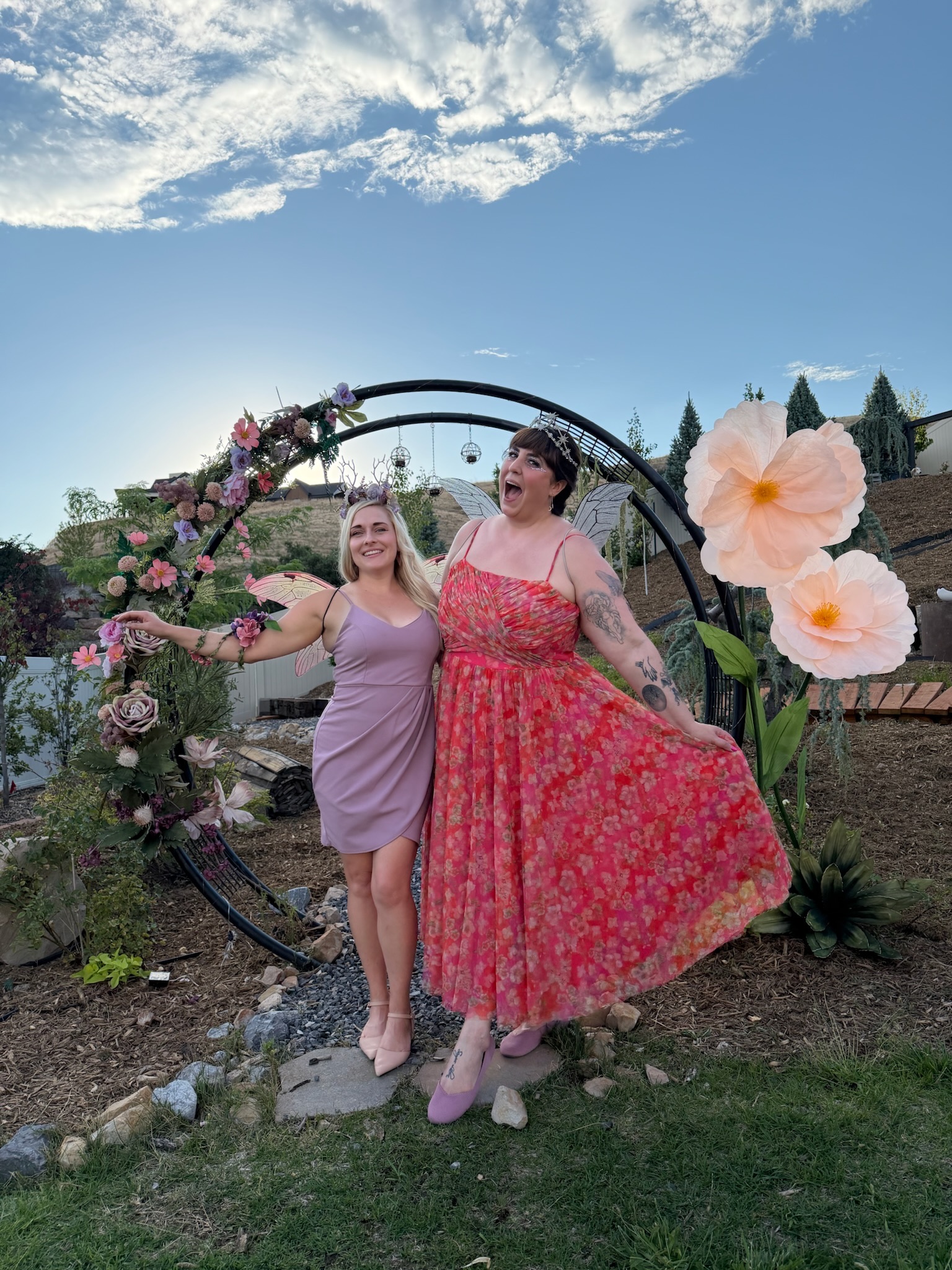
P.S. One little summer cover crop was the fairy-themed garden party I threw for my bestie Olivia’s birthday. Here we are as our truest selves. 🧚♀️🥹